Monday, June 20, 2016
Alpha Bakers -- Cherry Strawberry Rhubarb Pie

Tuesday, March 31, 2015
Alpha Bakers -- Rhubarb Upside Down Cake

Monday, August 2, 2010
Heavenly Cake Bakers: Lemon Meringue Cake
Every now and again, though, I do pull off a whopper. And this week's Heavenly Cake, a many-step Lemon Meringue Cake, was just such a show-stopper. This is the kind of cake I love to make, many steps without too much butter.
The cake itself was a very light biscuit, or sponge. After it had cooled, I removed the top and bottom crust by pinching and rolling and peeling it, a very satisfying maneuver that reminded me of peeling sunburnt skin, which I regret to say is also an activity recently engaged in by me.
The denuded cakes were brushed with lemon syrup, sandwiched with leftover rhubarb curd (which tastes remarkably similar to lemon curd), and then covered in huge clouds of one of the best Italian meringues I've ever made. For once the syrup didn't clump everywhere! For once the meringue stayed white and didn't turn caramel colored! I am awesome. Also, the meringue had lemon juice right in it, a nice touch.
For the final flourish, the cake went into the oven at 500 degress, where it proceeded to complete its resemblence to its namesake pie by browning beautifully.
The cake came together perfectly, but a touch of anxiety was added by my old enemy, transportation. Any cookbook or pastry chef will tell you that you can't make a perfect meringue on a humid day. Unfortunately for me, if I wanted to wait for a dry day in Brooklyn I'd be waiting until November, so I just decided to give it a try. Shortly after frosting, I noticed the beginning of telltale cracks in my perfect cloudy billows, so I took drastic action, and whisked the cake into storage in our air-conditioned bedroom. I fretted about it for the next several hours, and indeed it didn't make it to its destination dinner party unharmed and crisp, but it did arrive nearly perfect, and was greatly admired, and eaten up. I never got a slice shot, but if there were one you would see that the meringue rises nearly an inch and a half above the cake, providing the final homage to lemon meringue pie.
Sunday, June 20, 2010
Pie Frenzy
Pssst...back here...you want some pie, little girl...?
In fact, there was even a little girl, Jimmy's outgoing daughter Georgia, who, despite proclaiming her general indifference to pie, fell in love with the kosher salt garnishing Four & Twenty Blackbirds' 'Salty Honey' version, so I guess we did some mild dealing and corrupting of youth.
The event was one of my first forays into the wider world of Brooklyn foodie-ism, and my pie was in some very good company. I didn't get to taste everything, but I did get to meet some seriously accomplished pie bakers and urban gardeners, including, in addition to Emily and Melissa of the aforementioned Four & Twenty Blackbirds, Allison Kave of First Prize Pies, Betty Brooklyn (whose individual Short Rib and Stout pies carried off the People's Choice Award), Kat of Piety Bakery, Brooklyn Honey, Rooftop Farms (winner of the Best Savory), the SCRATCHBread team (who filled hollowed out bread with an incredible combination of orange cauliflower puree, mushrooms, greens, and grapes), Lauren of Pie in the Park, and many more, including the makers of some truly unforgettable goat meat pies dribbled with savory jus.
And my pie? Well, it was good. Knowing what I know now, I might have gone in a different direction, but for my rookie bake-off, it was a good effort. I went savory, and created a new recipe that I'd never tried before.
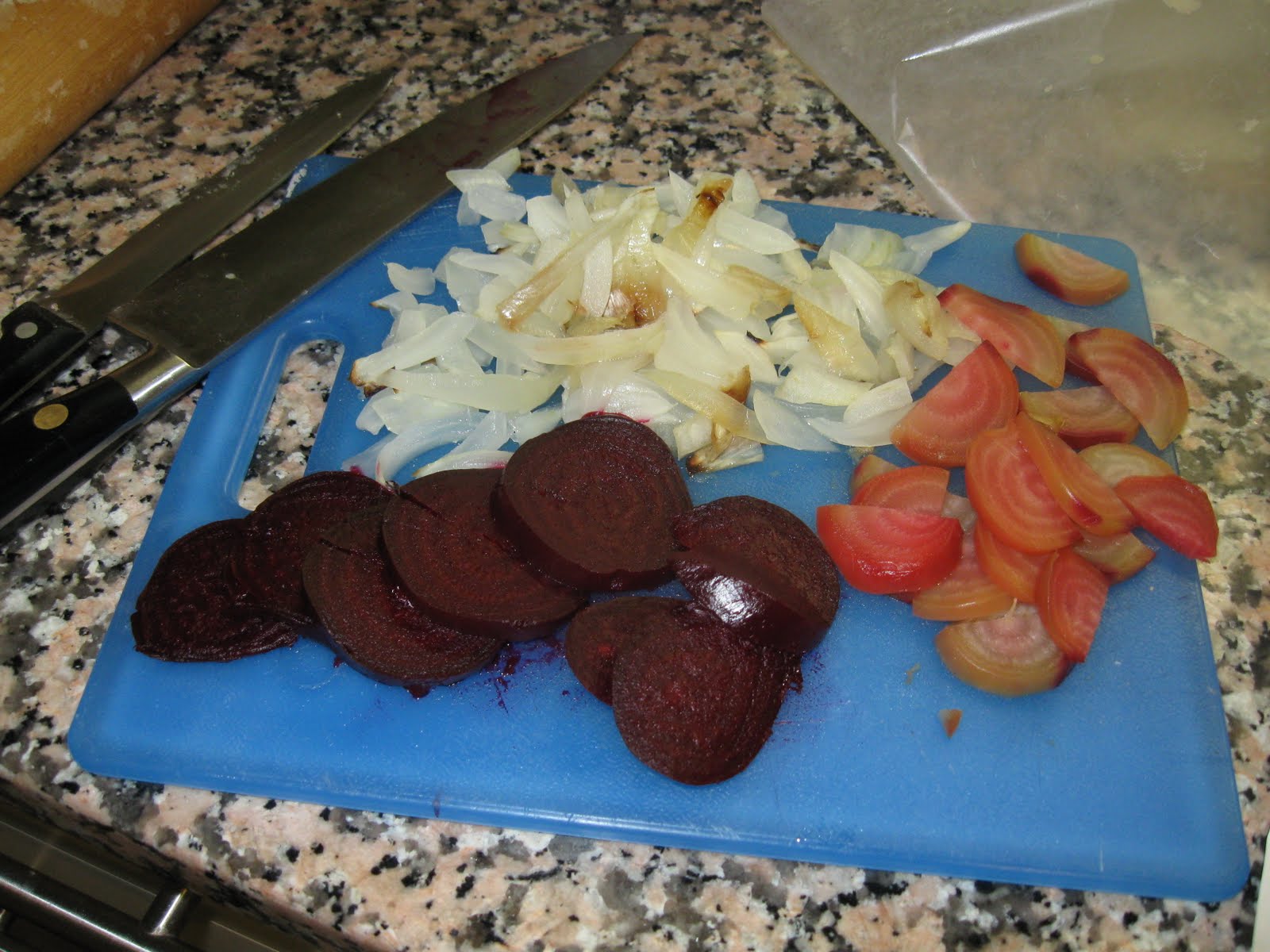
Over a bed of roasted Vidalia onions, I layered red and Chioggia beets in a concentric pattern. A savory custard filled out the pie, and I scattered toasted pine nuts and goat cheese on the top.
In retrospect, I would have mixed the goat cheese right into the custard, but all in all, it was a success. I think, though, that things would have gone even better if I had played to my strengths, made a custardy or fruity pie that I could love to pieces, rather than a very pretty beet pie that I couldn't be totally sure of (and I am kind of indifferent to beets, except that I do like cooking them). Still, this is all hindsight. I was proud of my pie, though it won no awards.
The bake-off did bring out my latent competive pie streak though--now I just can't wait to enter MORE BAKE-OFFS. And WIN. Or, you know, bake some more pies. Like I did this week. Seeing all those beautiful pies filled me with so many ideas, and so much desire to perfect my crust and crimping technique. Tough to do on such a hot an humid week, but I did manage two more pies, a double crust rhubarb pie and an old fashioned custard pie from the Joy of Cooking.
Friday, June 11, 2010
Tuesdays with Dorie: Tender Shortcakes
Yes, that one.
It's yellow because the rhubarb was green, not pink.
Thursday, May 28, 2009
Daring Bakers Challenge May 2009: Strudel!
This month, I also got to have fun making strudel. (Strooodel, strooodel...). It's one of those lovely words that quickly loses all sense and just becomes a collection of appealing nonsense sounds.
The May Daring Bakers’ challenge was hosted by Linda of make life sweeter! and Courtney of Coco Cooks. They chose Apple Strudel from the recipe book Kaffeehaus: Exquisite Desserts from the Classic Cafés of Vienna, Budapest and Prague by Rick Rodgers.
I was happy to see this challenge, not just because saying strudel is so much fun, but because Saveur recently ran an incredible photo spread on Viennese pastry, and I've been having warm thoughts about apfeltortes and the like ever since. Also, the recipe contained a new technique, and what else did I join Daring Bakers for? Lastly, this is exactly my kind of dessert, heaps of butter and fruit, nothing fancy or uber-decorated, and sans icing.
I don't think I've quite mastered the art of strudel yet, but I don't think it's as complicated as I'm making it. The dough is surprising and fun, so I'll probably try again.
Apple strudel
from “Kaffeehaus – Exquisite Desserts from the Classic Cafés of Vienna, Budapest and Prague” by Rick Rodgers
2 tablespoons (30 ml) golden rum
3 tablespoons (45 ml) raisins
1/4 teaspoon ground cinnamon
1/3 cup plus 1 tablespoon (80 g) sugar
1/2 cup (1 stick / 115 g) unsalted butter, melted, divided
1 1/2 cups (350 ml) fresh bread crumbs
strudel dough (recipe below)
1/2 cup (120 ml, about 60 g) coarsely chopped walnuts
2 pounds (900 g) tart cooking apples, peeled, cored and cut into ¼ inch-thick slices (use apples that hold their shape during baking)
1. Mix the rum and raisins in a bowl. Mix the cinnamon and sugar in another bowl.
2. Heat 3 tablespoons of the butter in a large skillet over medium-high. Add the breadcrumbs and cook whilst stirring until golden and toasted. This will take about 3 minutes. Let it cool completely.
3. Put the rack in the upper third of the oven and preheat the oven to 400°F (200°C). Line a large baking sheet with baking paper (parchment paper). Make the strudel dough as described below. Spread about 3 tablespoons of the remaining melted butter over the dough using your hands (a bristle brush could tear the dough, you could use a special feather pastry brush instead of your hands). Sprinkle the buttered dough with the bread crumbs. Spread the walnuts about 3 inches (8 cm) from the short edge of the dough in a 6-inch-(15cm)-wide strip. Mix the apples with the raisins (including the rum), and the cinnamon sugar. Spread the mixture over the walnuts.
4. Fold the short end of the dough onto the filling. Lift the tablecloth at the short end of the dough so that the strudel rolls onto itself. Transfer the strudel to the prepared baking sheet by lifting it. Curve it into a horseshoe to fit. Tuck the ends under the strudel. Brush the top with the remaining melted butter.
5. Bake the strudel for about 30 minutes or until it is deep golden brown. Cool for at least 30 minutes before slicing. Use a serrated knife and serve either warm or at room temperature. It is best on the day it is baked.from “Kaffeehaus – Exquisite Desserts from the Classic Cafés of Vienna, Budapest and Prague” by Rick Rodgers
1 1/3 cups (200 g) unbleached flour
1/8 teaspoon salt
7 tablespoons (105 ml) water, plus more if needed
2 tablespoons (30 ml) vegetable oil, plus additional for coating the dough
1/2 teaspoon cider vinegar
1. Combine the flour and salt in a stand-mixer fitted with the paddle attachment. Mix the water, oil and vinegar in a measuring cup. Add the water/oil mixture to the flour with the mixer on low speed. You will get a soft dough. Make sure it is not too dry, add a little more water if necessary.
Take the dough out of the mixer. Change to the dough hook. Put the dough ball back in the mixer. Let the dough knead on medium until you get a soft dough ball with a somewhat rough surface.
2. Take the dough out of the mixer and continue kneading by hand on an unfloured work surface. Knead for about 2 minutes. Pick up the dough and throw it down hard onto your working surface occasionally.
Shape the dough into a ball and transfer it to a plate. Oil the top of the dough ball lightly. Cover the ball tightly with plastic wrap. Allow to stand for 30-90 minutes (longer is better).
3. It would be best if you have a work area that you can walk around on all sides like a 36 inch (90 cm) round table or a work surface of 23 x 38 inches (60 x 100 cm). Cover your working area with table cloth, dust it with flour and rub it into the fabric. Put your dough ball in the middle and roll it out as much as you can.
Pick the dough up by holding it by an edge. This way the weight of the dough and gravity can help stretching it as it hangs. Using the back of your hands to gently stretch and pull the dough. You can use your forearms to support it.
4. The dough will become too large to hold. Put it on your work surface. Leave the thicker edge of the dough to hang over the edge of the table. Place your hands underneath the dough and stretch and pull the dough thinner using the backs of your hands. Stretch and pull the dough until it's about 2 feet (60 cm) wide and 3 feet (90 cm) long, it will be tissue-thin by this time. Cut away the thick dough around the edges with scissors. The dough is now ready to be filled.
Tuesday, May 13, 2008
Rhubarb Pie
The next morning, some evil imp of memory settles down to remind me that at the shake shack, you can get pie mashed right on yer ice cream. Hmmm.
Wednesday, May 7, 2008
Rhubarb-Apricot Oatmeal Muffins
These have become my muffin of choice these days, as my ability to make perfect plain muffins seems to have evaporated. When I first started making muffins from any book but the Joy of Cooking, all the recipes seemed too buttery and too cakey. These Apricot Oatmeal Muffins from the Curtis & Schwartz cookbook are buttery to the point of squashy, but not too sweet, and they always look beautiful because of the way the sugar is added at the last minute. Today, I added a little rhubarb to the dried apricots. Here is my slightly tweaked version of the recipe.
Apricot Oatmeal Muffins
adapted from the Curtis & Schwartz cookbook
makes 12 muffins
Preheat oven to 400 degrees farenheit.
Poaching Mix:
# 3/4 cup dried apricots (or other fruit of your choice. dried fruits work best, if using fresh, skip the poaching and add a little lemon zest or the spices of your choice to the batterHalf an orange, cut up
# 1 cinnamon stick
# 2 whole cloves
To poach apricots, place them in a small pot with the orange, cinnamon stick, and cloves. Cover the fruit with water and simmer until they are soft but not mushy, no more than 5 minutes. Drain, cool, and chop. Discard the orange and cinnamon.
Wet Mix:
* 2 eggs
* 1 1/2 cups buttermilk
* 1 1/2 cups rolled oats
* 6 oz unsalted butter
Combine the first three wet ingredients in a bowl and stir. Let sit 15 mins to 1/2 hour. Melt the butter and add it to the wet mix. Add the chopped fruit.
Dry Mix:
* 1 3/4 cups flour (i used whole wheat pastry flour from Wild Hive)
* 2 1/4 tsp baking powder
* 3/4 tsp baking soda
* 1/2 teaspoon salt
Combine the dry ingredients and add to the wet mix after the fruit, mixing until just combined.
Sprinkle the batter with:
* 3/4 cup brown sugar mixed with 1/2 tsp cinnamon
Gently blend the sugar mixture in, leaving streaks.
Fill a 12-cup greased muffin tin (filling cups full) and bake in the center of the oven for 20 minutes, turning halfway. Let the muffins cool in the pan for a few minutes before removing, they are very soft.
Thursday, May 1, 2008
Yogurt-Buttermilk Panna Cotta with Rhubarb Compote
Yogurt Panna Cottas with Honey
As printed on www.seriouseats.com, Adapted from Food & Wine magazine
Ingredients
1 1/2 teaspoons unflavored gelatin
1 tablespoon water
1 cup fat-free milk
1/3 cup sugar
1 cup low-fat buttermilk
1 cup fat-free plain Greek yogurt
2 tablespoons honey
Red grapes, for serving
Procedure
1. In a small bowl, mix the gelatin with the water and let stand about 5 minutes, until softened. In a small saucepan, bring the milk to a simmer with the sugar and cook until the sugar is dissolved, about 1 minute. Remove from heat and stir in the softened gelatin until dissolved.
2. In a medium bowl, whisk the buttermilk with the yogurt until smooth. Whisk in the warm milk mixture. Pour the panna cotta mixture into six 4-ounce ramekins and refrigerate until set, about 3 hours.
3. To serve, drizzle the panna cottas with honey and garnish with the grapes.